You may be deciding what to tell your children about the affair. That's an important question, but it’s separate from what I want to consider here. This is about what happens in the house while you're deciding.
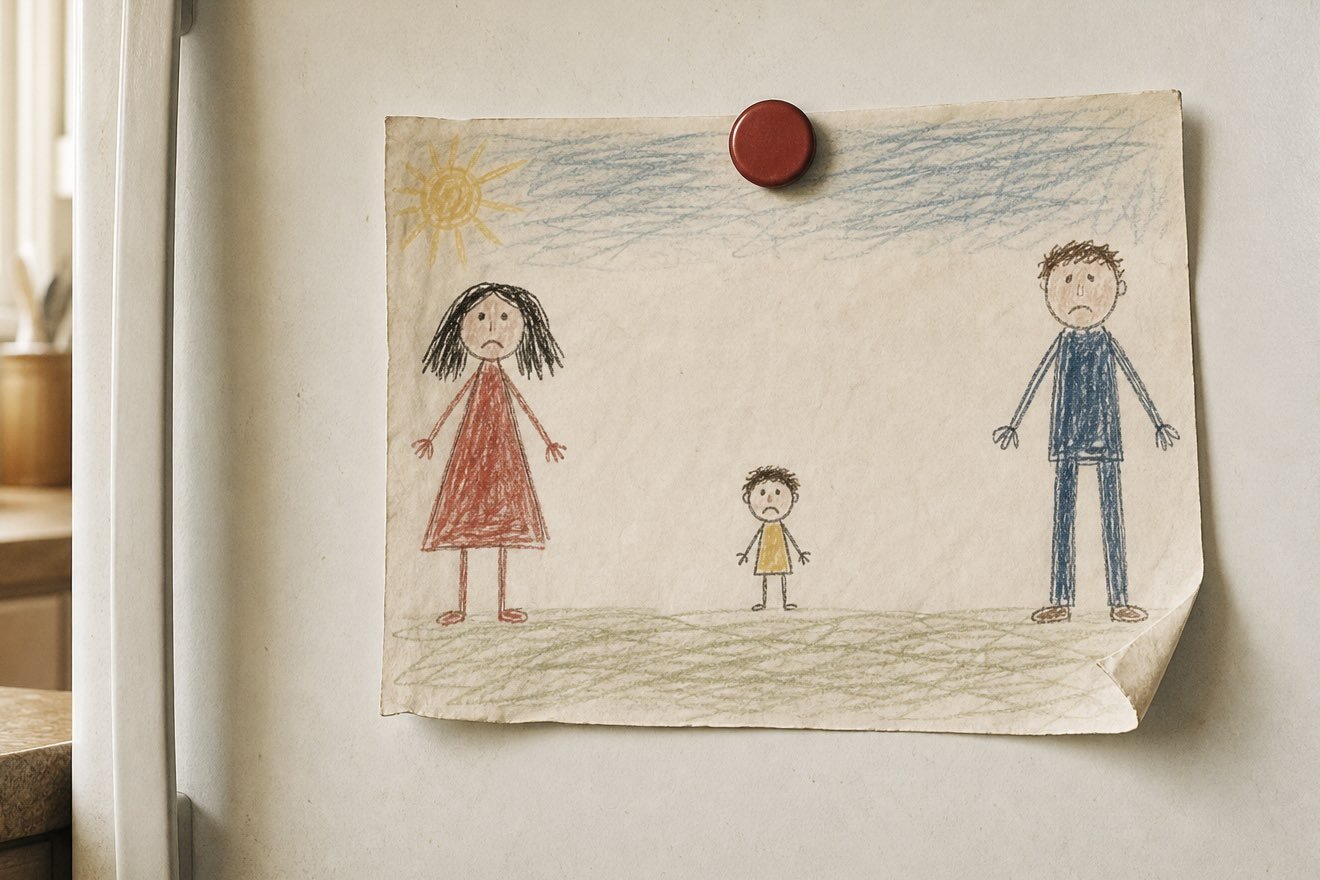
Children are not always good at knowing what’s wrong, but they are exceptionally good at knowing that something is wrong. They notice the change in the air when a parent leaves the room to take a call. They see that the two of you stopped touching each other. They hear a shift in the tone underneath your words, the silence that fills the mornings, the way a door closes a little harder than it used to.
Maybe they don’t know the cause, but they know something has changed. So they do what anyone does when the evidence and the explanation don't match: they look for a reason that makes some sense.
If you tell them nothing is wrong, they have two options. They can believe their own perception is unreliable, or you are. Younger children will usually choose the first because it is the less frightening conclusion.
One family therapy practice writes about this, calling it a possible form of unintentional gaslighting. That’s a strong label, but it accurately describes what’s happening. A child's lived experience simply doesn't match what they're constantly being told. That message teaches them that the feeling in their gut is something to be overridden; they learn to distrust what they can plainly see.
That's a bad lesson for a child to learn in any context. It's a particularly bad one to learn inside a family that's dealing with a betrayal, because the skill they're being trained out of is exactly the one that could protect them later.
There is another failure, one that is very different from the previous one. Instead of trying to protect a child by constructing a barrier of silence, the injured partner may actually draw them into the pain as a source of comfort.
It happens for understandable reasons. If you’ve been betrayed, you have suffered a significant injury. Your usual sources of support may be the very person who caused the pain. But your child is right there, and they're old enough to talk to, and they love you, and it is so tempting to let them see how much this hurts.
A child recruited into an adult's emotional processing is a child who has lost a parent and gained a new job. Teenagers are especially vulnerable to this because they can perform the role convincingly. They'll listen. They'll take sides. They'll ask how you're doing. They play the part of being more than a child while still being a child, and the cost of the role usually comes due years later.
Between the two extremes, what actually works is a focused response: acknowledge the change, withhold the details. “Something hard is going on between your dad and me right now. We're working on it. It isn't about you, and it isn't your fault. You're not imagining it.”
That last sentence is important. It discloses nothing while it protects the child's view of reality. It tells them their perceptions are valid; it reinforces the accuracy of their instincts so the child learns to trust them.
For the involved partner, there's a part of this that belongs specifically to you.
During your affair, your children were in the house, observing and learning. Whatever they absorbed, they absorbed during the months or years the concealment was running. The distraction they noticed, the tension they couldn't name, the parent who was physically present and somewhere else: that was already happening before anyone found out.
It's common to focus on the disclosure as the moment of damage and to want to manage that moment carefully. That’s a valid consideration, but the timeline is wrong. The disclosure isn’t the start of the family’s problem; it is the moment you identify the problem that has existed for a while — one that your kids, at some level, may have already been aware of.
So, caring for your children isn't primarily about figuring out what to tell them. It's about becoming someone whose presence matches their perception, so what they observe and what they're told no longer contradict each other. Children understand behavior far more accurately than they understand explanations.
One more thing for the injured partner: You are being asked to stabilize your child's reality at a moment when your own has come apart. That is an unreasonable request. You didn't cause it, but you still have to take some responsibility for how things play out. It’s not fair, I know, but your children deserve your effort.
It helps to have the support of others. Not your children. Adults: a therapist, a group, a friend who can hear the whole thing. Your healing needs witnesses who join you, at some level, in taking the next step.
None of this requires you to have decided what to tell your children about the infidelity. You can be entirely undecided about what your children will eventually be told and still give them the one thing they need today: confirmation that what they're noticing is real. It’s telling them you're not imagining it.