When the Life You Perform Isn't the Life You're Living
Kristy and Desmond Scott built something most couples only dream about. They met at fourteen, married a decade later, and turned their life together into one of social media's most beloved brands—nearly thirty million followers watching them cook, prank each other, renovate their dream home in Houston, and raise their two sons. In October 2025, Kristy was doing backflips in Gucci heels. Twenty-one days later, she filed for divorce.
The filing cited infidelity. In the court documents, Kristy stated that the betrayal had completely wiped out any reasonable chance of reconciliation. Desmond broke his silence a day later on Instagram, acknowledging he had made "choices I am not proud of." That was careful language from a man whose entire public identity had been built around being the devoted, long-suffering husband who adored his wife anyway.
The internet reacted the way it always does: shock, grief, the particular sting of feeling deceived by people you never actually knew. I’d like to focus on that last part a little more.
Thirty million people had a relationship with the Scotts' marriage. Not with Kristy and Desmond as complicated human beings navigating real life together, but with the version of them optimized for engagement. That audience was, in a very real sense, a third party in their relationship. Their marriage didn't just belong to them. It belonged to the brand. And when the brand collapsed, thirty million people felt the loss of something that was never quite theirs to lose.
I know something about this from the other side.
For years I served as a pastor in a large church. Not a background role. I was on the platform regularly as a worship leader and teaching pastor. Our services were televised. People recognized my face in cities hours from home. I represented something to them: a man who had his life together, whose faith, character, and marriage were presumably aligned.
They weren't. Not entirely. I was having an affair.
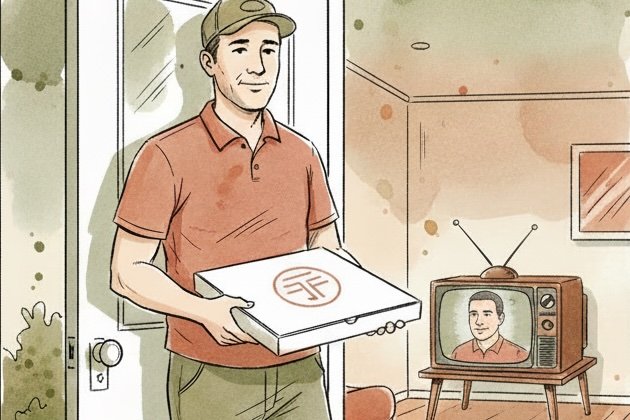
When it came out, it became public news. I lost my job. For several months, I delivered pizzas to supplement my income. More than once, I knocked on a door, and the person on the other side recognized me. “Hey, you’re that guy!” Some offered grace. Others quickly ended the transaction without another word. The distance between the person I had been on that platform and the person standing at their door holding a pizza box was not lost on me.
What I understand now, that I couldn't see then, is that I had confused my reputation with my identity. My vocation depended on projecting a certain image—faithful, principled, steady—and I had become good at it. So good that the gap between that outward image and the inward reality stopped feeling like a problem to solve; it became something to manage.
That is not a sustainable way to live, but the experience isn't unique to pastors or influencers. It's available to anyone whose sense of self gets tangled up in how others see them.
I don't know what was happening inside the Scotts' marriage. What I do know is that a brand built on togetherness creates its own particular pressure to keep performing togetherness even when the reality has quietly shifted. The audience doesn't know the difference. They're watching a highlight reel. And the person producing those highlights can start to lose track of which version is the real one.
The lesson I eventually carried out of my own wreckage wasn't about discipline or accountability, though those matter. It was simpler and harder: live as the same person in every space. The person on the platform, the person at home, the person alone. If those versions can't be reconciled, the gap will find a way to close itself, often with inconvenient timing.
The Scotts' story is still unfolding. Whatever comes next for them, the brand is gone. What remains, if they're willing to do the work, might be something more durable for their relationship, or for their individual lives.
When we stop performing, we can discover a life that’s more worth living.