Review: Beyond Infidelity
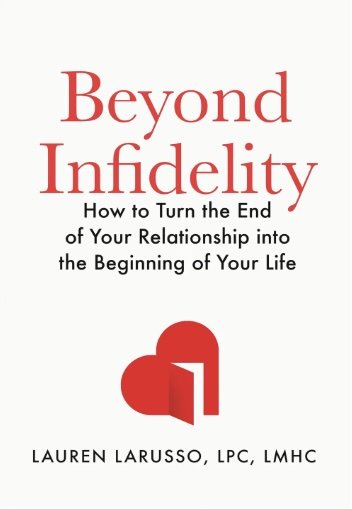
Beyond Infidelity: How to Turn the End of Your Relationship into the Beginning of Your Life
Written by Lauren LaRusso
Every now and then, an exceptional book on affair recovery comes along. This is one of them. Listen to my podcast interview with Lauren.
—Tim Tedder
Review
I've spent more than twenty years sitting with people in the aftermath of infidelity, and I've read much of what's been written for them. Too often, new affair recovery books are just repackaging what’s already available without improving on the well-established resources.
Beyond Infidelity, however, offers a fresh perspective from a knowledgeable writer, presented in an easily accessible way for readers. That’s why I highly recommend this book.
LaRusso is a psychotherapist who was seven years into practice when she found out about her husband's affair. She writes about that morning in enough detail that you understand something important: professional training is not armor. She was as unprepared as anyone. What follows in the book is not the wisdom of someone who watched from a chair, but of someone who had to find the path while walking it, then went back and mapped it for the rest of us.
The book guides you on a journey from basic stabilization, to a changed outer world, to the harder interior work, to something she calls thriving. It's structured, with reflection prompts and exercises throughout, but it never reads like a workbook. Lauren’s writing is warm, direct, occasionally funny, and without judgment.
Two things impressed me most.
The first is how carefully she holds the line on responsibility. Her chapter asking the betrayed partner to examine their own role in the marriage is the kind of material that goes wrong constantly in this field, and she does not let it go wrong. She draws a clean, explicit distinction between a person's role in a relationship and responsibility for someone else's betrayal, and she keeps drawing it. Her reason for asking the reader to do the work at all is not moral obligation but self-interest: unexamined patterns follow you into whatever comes next. That framing is exactly right, and I wish more clinicians used it.
The second is her refusal to give easy answers in a situation that is almost never black-and-white. For example, her insistence on holding two truths at once: a marriage can have given you something real and ended in devastation; you can have loved well and still carried negative patterns worth understanding. And she refuses to let the ending define the whole story, and for readers whose instinct is to declare the last twenty years a lie, that refusal is a genuine kindness.
I should say plainly that this is not a reconciliation book, and readers hoping to rebuild will need other resources alongside it. It also deliberately sets aside the question of why affairs happen (a question I've built a good deal of my own work around and one that Lauren plans to address in her next book). But those are boundaries she names openly in the opening pages, not blind spots.
If your marriage has ended, or may be ending, and you are trying to figure out who you are on the other side of it: this is the book. It will meet you where you are, and walk with you through the process.
Quotes
Here are a few quotes from the book.
You’re not reading this book to get through this. You’re reading this book to grow through this.
You brought your 50 percent to the relationship, and it’s time to stop giving yourself 100 percent of the blame.
When a relationship ends, especially in the shocking pain of betrayal, it’s easy to let that ending define your entire story. But here’s something I often tell my clients: How it ended isn’t necessarily how it went.
Taking responsibility for yourself—and only for yourself—is the most liberating act of self- respect there is. It allows you to reclaim the parts of you that got lost in the mix, to unearth what was yours and what never was. And it invites you to take what you’ve learned into your future; not as baggage, but as wisdom.
[Writing about a painful moment, five years after her divorce] …when I put my daughter on the school bus in the pouring rain, I was slammed with a very different feeling—heavy heartbreak. It was one of the many weekends she’d be with her father, which was nothing new… but as she stepped up into the bus, she turned around and called out with a sweet urgency in her voice: “When will I see you again, Mama?” Her little voice, her words so full of hope and the eagerness to understand what comes next, flew at me like an arrow to the heart and shattered me in an instant… Out of nowhere, I was hit with one of those surges of grief that takes your breath away. I stood frozen on the sidewalk, rain mixing with tears, trying to pretend it was just the weather blurring my vision.
To thrive beyond infidelity is to live in the both/and: The grief and the gratitude.
Do you have a book to recommend? Tell us about it.