Is Affair Healing Biased? A Response to Criticism
This article was written in response to a message submitted in our contact form. For easier readability, I corrected grammar and punctuation and rearranged the order of the author’s statements so my responses flow more logically. I have included the full message, as written, at the bottom of the page.
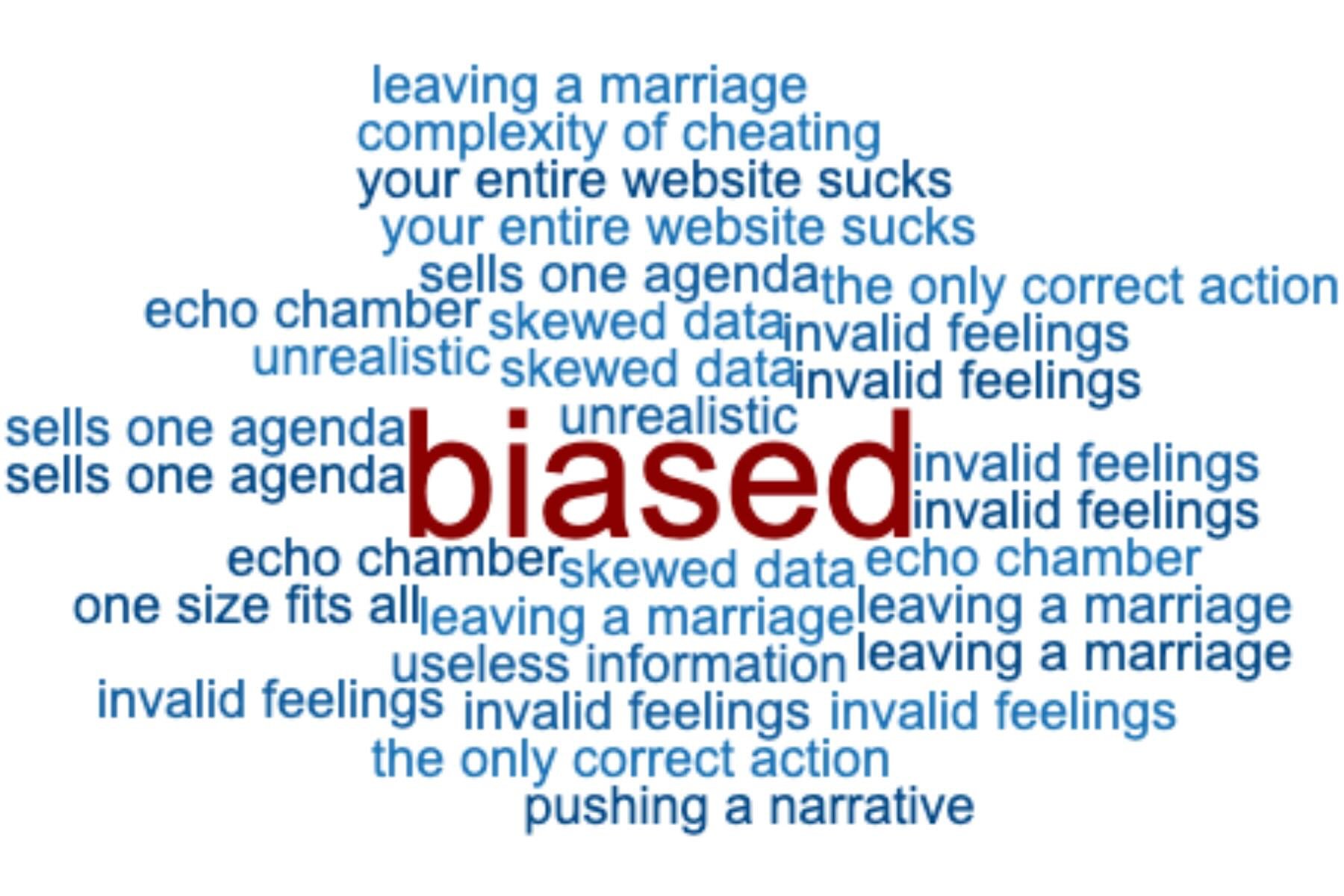
I recently received a critical message from David, a visitor to this website. Criticism is never fun, but I want to be someone who is open to listening and, if needed, to change. I sat with this for several days before deciding to respond. You can read his full message below, but let me break it down and provide my feedback on his observations.
“Just wanted to reach out and let you know most of your website is based on a biased perception… the bias to stay in a marriage that the wayward person already stepped out on is the ONLY correct way… Go educate yourself more on the complexity of cheating and healing. There’s no one size fits all.”
If there’s one point in David’s message I can agree with immediately, it’s this: there is no one-size-fits-all outcome after infidelity. Some couples rebuild their marriage. Some separate. Some divorce. Some try to repair and later decide they can’t. Some discover that leaving is the most honest and humane choice available.
I do not believe staying married after an affair is the only “correct” option. I never have.
What is true is that AffairHealing.com has historically focused more on the possibility of repair than on separation. That reflects the kinds of people who most often come looking for help here. It does not mean reconciliation is mandatory, morally superior, or universally healthier. It means we start with the question: Is healing possible here? Sometimes the answer is yes. Sometimes, after honest effort, the answer is no.
Acknowledging that complexity isn’t bias. Pretending all choices carry the same emotional, relational, and ethical weight would be.
“For a ‘counselor’ run site you’re really pushing a biased narrative while encouraging people to not find other supports system that would confirm their own bias, which may not be biased for the cheating person at all but instead valid feelings.”
This is an important concern that deserves clarity.
I am not opposed to people seeking support that validates their feelings. Infidelity is emotionally overwhelming, and shame thrives in isolation. Support and validation matter.
What I do caution against is support that functions as an echo chamber. There’s a difference between someone who helps you feel understood and someone who helps you avoid uncomfortable truths. There’s a difference between validation and rationalization.
When I encourage people to talk with someone who won’t simply “confirm their bias,” I’m talking about finding support that helps slow things down, widen perspective, and increase honesty. Not someone who pressures them to stay. Not someone who pressures them to leave. Someone who helps them tell the truth, to themselves and to others, and live with integrity as they decide what comes next.
Valid feelings still deserve careful reflection. Strong feelings don’t automatically make decisions wise.
“Cheating and leaving a marriage is not easy, but it doesn’t mean that being guilted into staying is the better way forward.”
On this point, I want to be very clear: guilt is not a healthy foundation for staying married.
If someone remains in a marriage primarily because they feel pressured, shamed, or morally cornered, the marriage will likely collapse under that weight. Staying out of guilt simply trades one kind of harm for another.
When I write about consequences, impact, and responsibility, my aim is not to guilt people into staying. It’s to invite them to fully reckon with the effects of their choices—on their partner, their children, and themselves. Leaving may be the right choice. Staying may be the right choice. But neither should be chosen to escape discomfort. Hard decisions deserve to be made with eyes open, not with emotional blinders on.
“And revisit the statistics for affair relationships ‘ending in the first few years’ (reasons that your article listed a cheating spouse to stay) because it’s since been disproven that those surveyed were limited and skewed data.”
This is the most substantive critique David raises, and it’s a fair one.
There is no perfect data set that tracks all relationships that began as affairs. There is no uniform definition of “infidelity” used for various surveys. And, as David pointed out, people understandably don’t want to disclose that origin, which limits large-scale, definitive conclusions. Any counselor who claims otherwise is overstating the science.
That said, what research does consistently show is that relationships formed through infidelity tend, on average, to face higher challenges around trust, security, and long-term satisfaction than relationships that didn’t begin that way. That doesn’t mean these relationships can’t last. Some do. (I’ve counseled and helped some of them. Someone close to me is in a marriage that started as an affair twenty years ago.) It does mean the odds are different, and the challenges are real.
If I’ve overstated certainty in any article—or relied on outdated or overly simplified statistics—that deserves correction. I’m committed to revisiting those sections and being more precise about what we know, what we suspect, and what we simply can’t measure well.
Careful thinking requires humility, especially when people are making life-altering decisions.
“Your entire website sucks and is filled with useless information…”
Ouch.
I won’t pretend that comment doesn’t sting a bit. I’ve spent years working with individuals and couples in pain, and I know many people who’ve found these resources genuinely helpful. At the same time, I also know that when someone feels unheard, dismissed, or harmed by an idea, frustration often spills over.
So I’ll say this: if this site didn’t help David, I’m genuinely sorry. Not every resource fits every person. That doesn’t make the work useless, but it does remind me that tone matters, language matters, and assumptions deserve regular re-examination.
I’ll keep listening. I’ll keep refining. And I’ll keep holding space for disagreement, however it shows up.
The unedited message:
“Just wanted to reach out and let you know most of your website is based in a biased perception. In many articles (most specifically Affair Fog) the references to the person who cheated “being in a fog, not real, not thinking of family consequences, hurting others” and encouraging the cheater to speak to someone “who won’t confirm their biased” but all of these statements are actually confirming the alternative bias, that the bias to stay in a marriage that the wayward person already stepped out on is the ONLY correct way. This minimizes the complexity of cheating and pushed the agenda that the only correct action forward is to stay after the affair and work and recover the marriage. Which is NOT the only way. For a “counselor” run site you’re really pushing a biased narrative while encouraging people to not find other supports system that would confirm their own bias, which may not be biased for the cheating person at all but instead valid feelings. Cheating and leaving marriage is not easy, but it doesn’t mean that being guilted into staying is the better way forward. Your entire website sucks and is filled with useless information that only sells one agenda. Go educate yourself more on the complexity of cheating and healing. There’s no one size fits all. And revisit the statistics for affair relationships “ending in the first few years” (reasons that your article listed a cheating spouse to stay) because it’s since been disproven that those surveyed were limited and skewed data that’s been manipulated in modern day to say that most affair relationships don’t last. In actuality you can’t confirm how many relationships began as affairs because there’s not enough people who want to acknowledge that their relationship started as an affair. And successful relationships do not always end in marriage, sometimes they continue on as successful long term partners. So please revisit your stats you’re selling and the dialogue your peddling that IS BIASED while encouraging people to only see the core view of never leaving because “hurting others, it wasn’t real, these affairs don’t last.”
—Dave M.